
The 2003 Government Procurement Reform Law sought to reform government procurement procedures in order to eliminate or minimize procurement-related corruption by mandating a more transparent process. This includes the presence of third party observers in the activities of the Bids and Awards Committees that approves these procurements. Millions and even…...


The Conditional Cash Transfer Program Watch Project
The Conditional Cash Transfer (CCT or 4Ps) Program is at the centre of the Government’s effort to reduce the incidence of extreme poverty in line with its commitment to meet the poverty reduction target set by the Millennium Declaration of 2000. The CCT, also known as the Pantawid Pamilyang Pilipino…...

Monitoring Road Construction in Abra Province, Philippines
Concerned Citizens of Abra for Good Government (CCAGG), a local CSO, set out to strengthen and enhance the transparency and ethical standards within the agencies involved in the water and irrigation systems sector in the Abra province. Key objectives of the “Abra Water and Irrigation Systems (AWIS) Watch Project” included…...

Lessons from the CARTA Program in Bangladesh and Nepal
Recent years have witnessed concerns about issues of government effectiveness and accountability, particularly in the delivery of public services. Citizen engagement is increasingly recognized as a method to help improve development program effectiveness. This report reviews the unique initiative to enhance World Bank projects by promoting CSO engagement to demand…...
Citizen Action for Results, Transparency and Accountability (CARTA) Independent Assessment Report
The Citizen Action for Results, Transparency and Accountability (CARTA) Program was funded by a US$1.9 million grant from the Japanese Social Development Fund (JSDF). The grant was managed by the World Bank. CARTA started in mid-2011 and will be completed by November 30, 2015 after it was extended by more…...
Open Government Partnership (OGP) and Sustainable Development Goal Number 16 (SDG#16): Similarities and Differences
This paper is a modest contribution to a main focus of the upcoming 2015 Open Government Partnership (OGP) Global Summit: How principles of open government can support compliance with the Sustainable Development Goals of the United Nations Post-2015 Agenda. The specific question we address within this broader context is “What…...

Citizen Engagement and Social Accountability Approaches in Enhancing Integrity of Conditional Cash Transfer Programs
Conditional cash transfer programs (CCTPs) are widely used in the world and are proving effective in generating proven poverty alleviation impacts. However, CCTP achievements are undermined by fraud, errors, and corruption. These integrity risks and international experiences in managing them by using both state and civil society-led efforts have been…...
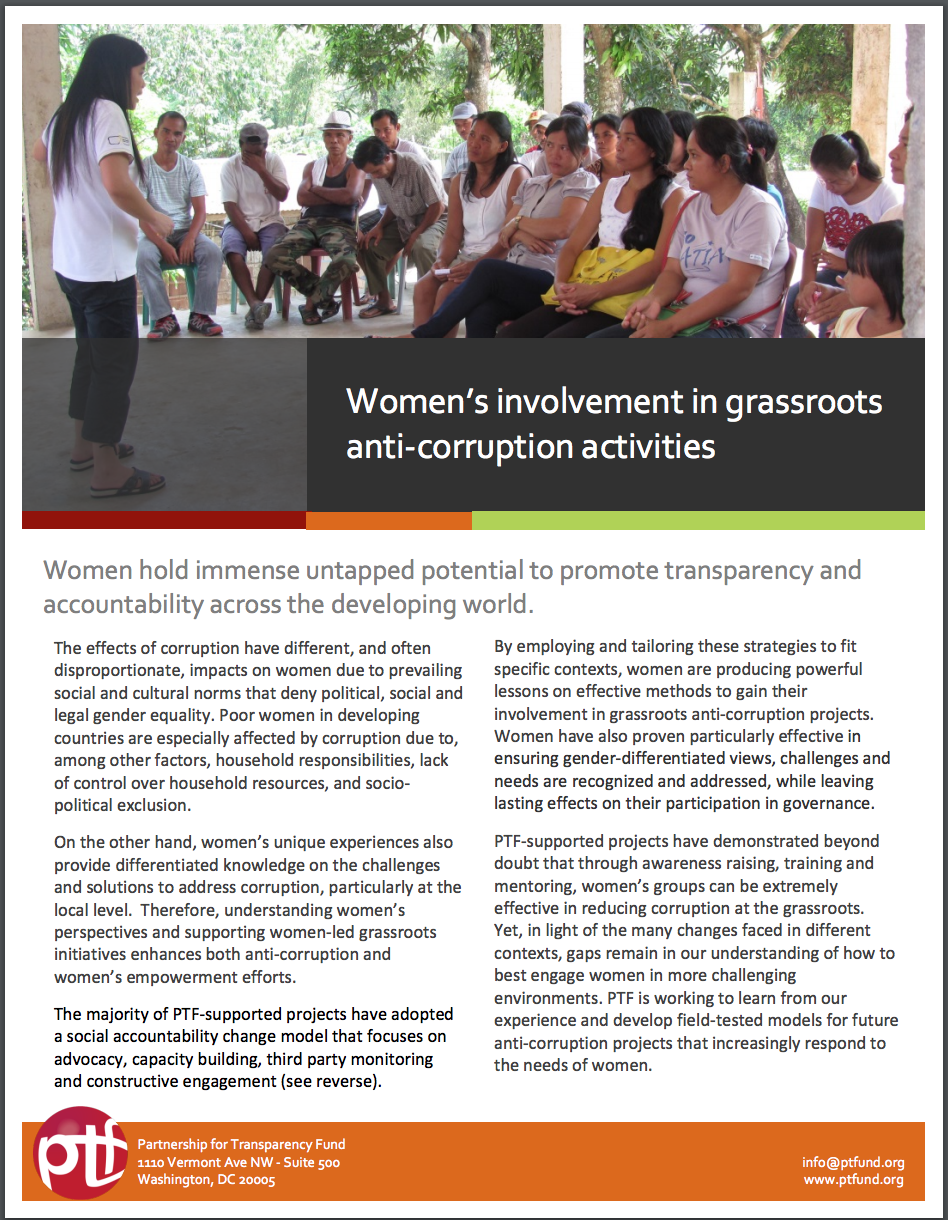
Women’s Involvement in Grassroots Anti Corruption Activities
The effects of corruption have different, and often disproportionate, impacts on women due to prevailing social and cultural norms that deny political, social and legal gender equality. Poor women in developing countries are especially affected by corruption due to, among other factors, household responsibilities, lack of control over household resources,…...